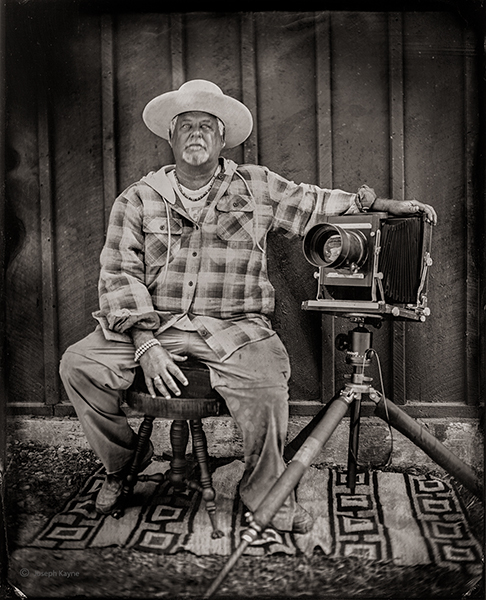
About Joseph Kayne
“A photographer went to a socialite party in New York. As he entered the front door, the host said, ‘I love your pictures - they’re wonderful; you must have a fantastic camera.’ He said nothing until dinner was finished, then: ‘That was a wonderful dinner; you must have a terrific stove.”
– Sam Haskins
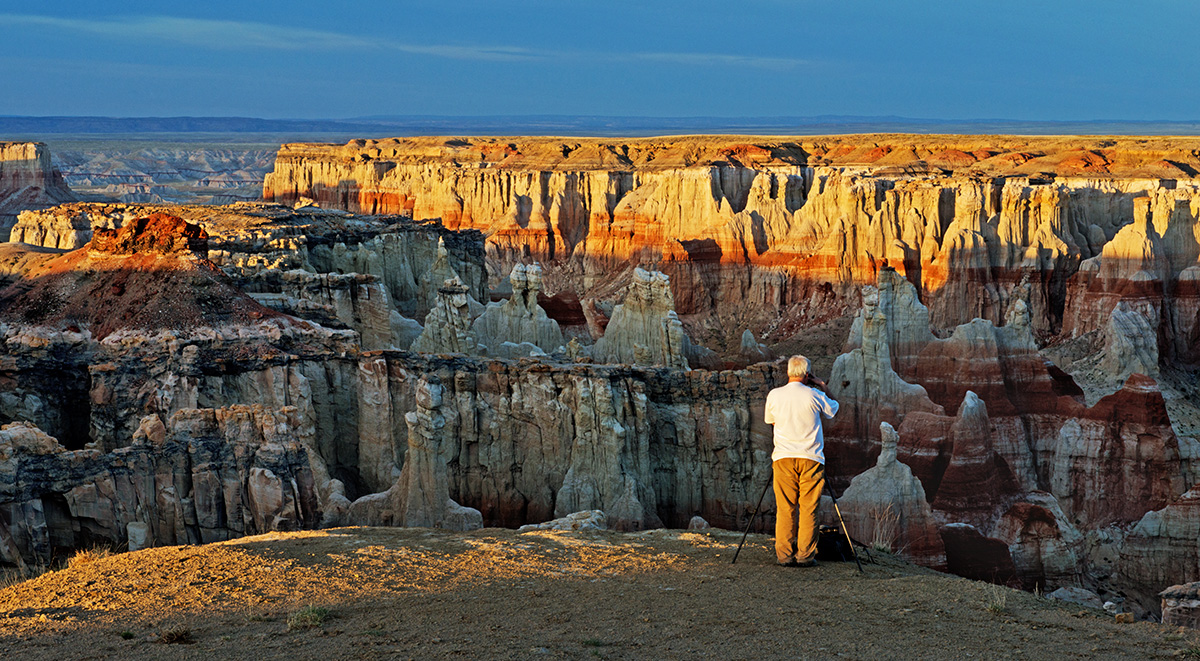
Joseph Kayne photographs the American landscape, Heartland, and Native American archaeological sites with a 4x5 large format view camera. His latest projects, involve working in the rare antique process, known as Wet Plate Collodion Tintype photography, using an 8x10 old wooden camera and a brass Petzval lens from 1870. Joe has tintype studios in Chicago and in Taos, New Mexico. Joe’s photographs have been exhibited in galleries, museums, and private collections across the country, including the National Portrait Museum-Smithsonian (permanent collection), Harwood Museum of Art-Taos (permanent collection), Heard Museum (library collection), Couse-Sharp Historic Site-La Luz de Taos 2024 Gala Weekend, and the Museum of Natural History, and his tintype of Deb Haaland was shown on The Rachel Maddow Show. He was a Top 50 Finalist in Photolucida's Critical Mass 2024. Joe's clients include The Nature Conservancy, Sierra Club, National Audubon Society, CF Martin Guitar Co., and the U.S. Department of Energy. Joe has a rare collection of large format images of the tallgrass prairies and American barns. He was one of the first color photographers to portray the Anasazi archeological sites and dwellings as an art form, and he is well known for his barn images and large format nature photography. Joe was awarded 3 artist residencies by the U.S. National Park Service at the historic Navajo trading post, Hubbell Trading Post in the heart of Navajo Nation, and has had several artist residencies at Native American owned galleries and jewelry designers, collaborating with, and making free tintype portraits for, Native Americans.
Joe’s interest in photography started while he was working in archaeology in Egypt and Israel during his college years. He received an art grant from the City of Chicago and has been a featured lecturer at the View Camera Magazine Large Format Photography Conference. Joe’s publication credits include: Lenswork (multiple), View Camera magazine, Lenswork-Bonus Edition, Black and White Magazine, Sierra Club, Arizona Highways, Outside Magazine, Audubon Calendars (cover), Nature Conservancy (cover), Elements Magazine, Camera Obscura Magazine (cover), Medium Format Magazine (multiple), Photo Life magazine, Natural History, Cowboys & Indians magazine, Chicago Tribune, and LEADING THE WAY—the Wisdom of the Navajo People, a teaching magazine. Joe was a featured photographer and named a “Lord of the Landscape” in Outdoor Photographer magazine’s landscape collector’s issue and is recognized as a long time large format nature photographer. Joe's images have been presented on The New York Times LENS live blog and was one of six photographers to know now in New Mexico Magazine (2026).
Joe's Navajo & Hopi Tintypes are part of the The Chicago Project representation at the Catherine Edelman Gallery in Chicago. Joe was selected to participate in Blue Rain Gallery (Santa Fe) Guadalupe Project in November 2024. Three of Joe's photographs were included in EGO, a photo exhibition with a focus on the exploitation, glorification and objectification of the individual, in the main gallery at the Zhou B Art Center, Chicago (August-September 2013). His images have also been included in exhibits at Southeast Center for Photography, Jackson-Junge Gallery in Chicago, and Perspective Photography Gallery, and Evanston Art Center, in Evanston, Illinois. Several of Joe's tintype images are part of the Native curated exhibit Of This Place at the Burpee Museum of Natural History in Rockford, Illinois. One of Joe's tintypes of a Navajo woman with a MMIW handprint was selected for the 2023 LENS international juried show at Perspective Gallery (Christa Dix, juror), and VICINITY2023, Perspective Gallery (juror Kristin Taylor, Curator of Academic Programs & Collections at the Museum of Contemporary Photography). Joe is an ally and frequently supports and donates to Native causes including, without limitation, the Oki Language Project for Eugene Braverock.